Review: Deck of Haunts
Deck of Haunts: A Macabre Architectural Deckbuilder That Doesn’t Quite Realize Its Potential
In the ever-expanding pantheon of deckbuilding games, one occasionally encounters a title that aspires to architectural grandeur yet ultimately resides in a more modest dwelling. Deck of Haunts, the latest offering from developer Mantis, presents itself as a novel amalgamation of spatial management and card-based strategy, inviting players to assume the role of a malevolent domicile intent on terrorizing its unwitting visitors. While the premise is undeniably enticing, the execution leaves one with the distinct impression of potential unrealized—rather like a haunted mansion with several wings perpetually under construction.
The Architectural Conceit
The fundamental conceit of Deck of Haunts is refreshingly innovative. Players are tasked with designing and expanding a haunted house, strategically placing rooms during daylight hours to create a labyrinthine deathtrap, then employing cards to terrorize and eliminate nocturnal visitors. The dual-phase gameplay creates a compelling rhythm, alternating between contemplative spatial planning and more reactive tactical card play.
The house-building mechanics demonstrate considerable sophistication, allowing for intricate layouts that would impress even the most discerning architectural enthusiast. One may arrange rooms to create false paths, bottlenecks, or elaborate mazes, all while protecting the vital “Heart room” that serves as the nexus of one’s supernatural power.

The spatial arrangement elements evoke comparisons to the underappreciated gem Sanctum of Decay, though Deck of Haunts eschews that title’s emphasis on symmetrical design in favor of more organic, asymmetrical layouts. This freedom of design is both liberating and strategically nuanced, allowing for personalized expressions of architectural malevolence.
However, I found myself jotting extensive notes in my leather-bound journal (with my cherished Montblanc fountain pen, naturally) regarding a critical design flaw: the game ultimately incentivizes a rather prosaic approach to spatial design. Despite the apparent freedom, optimal play invariably involves creating compact arrangements of small rooms rather than the grand, elaborate mansions the aesthetic suggests. This disconnect between thematic aspiration and mechanical optimization represents a missed opportunity for truly integrated design.
The Deckbuilding Foundations
The card-based elements of Deck of Haunts demonstrate a respectable understanding of deckbuilding fundamentals, though they lack the mechanical depth one might expect from a premium offering in this increasingly sophisticated genre. The starting deck offers a serviceable foundation, with basic haunting effects that can be augmented through upgrades and new acquisitions as one progresses.
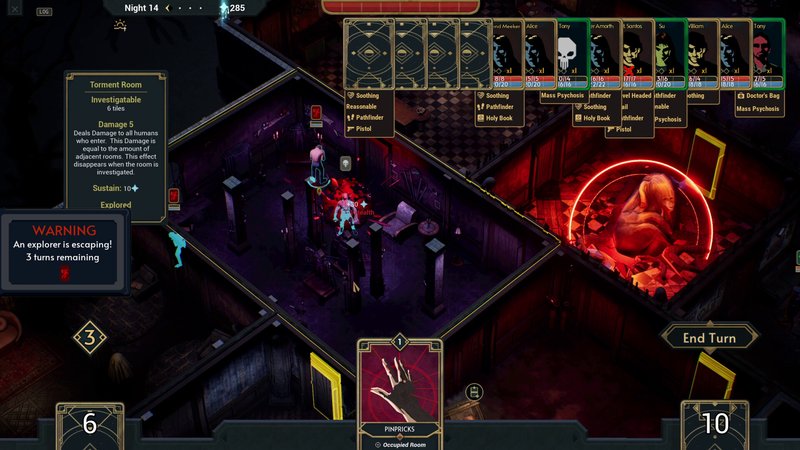
The cards themselves are visually striking, featuring evocative names like “Chilling Cold,” “Oikophobia,” and “Shifting Hallways” that effectively communicate their thematic purpose. The artwork embraces a gothic-industrial aesthetic that complements the overall visual design, though it occasionally lacks the distinctive personality that elevates truly exceptional card games.
Strategically, the card system offers moderate complexity. Players must balance immediate tactical concerns (eliminating approaching investigators) with longer-term strategic considerations (building card synergies and managing resources). The tension created by the “WARNING” notifications when investigators approach the Heart room provides genuinely engaging moments of tactical decision-making, reminiscent of the excellent crisis management systems in Meteorfall: Krumit’s Tale, albeit with less elegant implementation.
Unfortunately, the card pool lacks sufficient depth to sustain extended engagement. After several playthroughs, one begins to identify optimal strategies that, once discovered, significantly diminish the game’s challenge. The absence of meaningfully distinct archetypes or build paths further constrains the strategic landscape, resulting in a game that feels somewhat solved after minimal exploration.
The Aesthetic Foundations
Visually, Deck of Haunts presents a commendable, if not extraordinary, aesthetic. The isometric perspective provides an effective vantage point for surveying one’s domain, while the atmospheric lighting—particularly the ominous crimson glows emanating from certain rooms—creates a suitably macabre ambiance.
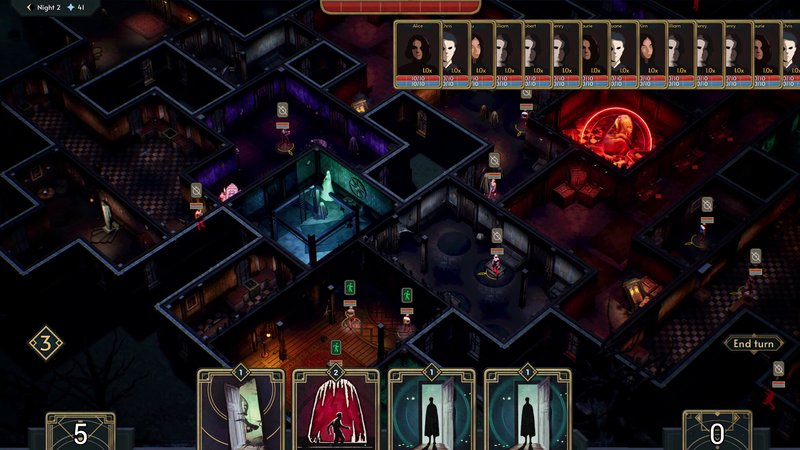
The interface design demonstrates a reasonable balance between functionality and thematic integration, with elegantly framed card displays and intuitive resource indicators. The character portraits, representing the various investigators foolish enough to enter one’s domain, are serviceable if somewhat generic in their execution.
The sound design warrants particular commendation, with creaking floorboards, distant moans, and other auditory hallmarks of the haunted house genre effectively deployed to enhance immersion. The musical score, while not particularly memorable, provides an appropriately tense backdrop to the proceedings.
The Mechanical Integrity
The core gameplay loop of Deck of Haunts offers a satisfying rhythm, alternating between the contemplative daytime phase of house construction and the more reactive nighttime phase of haunting. This dual-phase approach creates natural peaks and valleys in player engagement, preventing the fatigue that can afflict more monotonous deckbuilders.
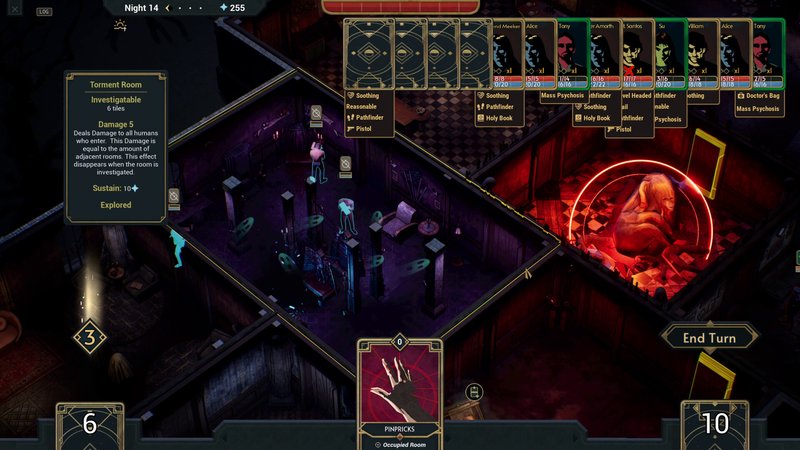
The progression system, however, reveals significant structural weaknesses. The game’s 28-day cycle provides insufficient time for meaningful strategic evolution, with the experience concluding just as one begins to access the more interesting card combinations and room types. This premature conclusion creates a peculiar sense of incompleteness, as though one had been ejected from a theatrical performance midway through the second act.
More problematically, the roguelite elements feel perfunctory rather than purposeful. Each new run begins with identical starting conditions—the same deck, the same initial house layout, the same progression of events—creating a sense of déjà vu that undermines the genre’s emphasis on variability and adaptation. The difficulty modifiers offer some variation, but insufficient to sustain extended engagement.
The game’s economic systems demonstrate reasonable balance, though the essence-gathering mechanics incentivize a rather one-dimensional approach to victim management. The strategic trade-off between driving visitors to madness versus outright elimination is intriguing in theory but underdeveloped in practice, with optimal play typically favoring one approach regardless of circumstance.
The Final Assessment
Deck of Haunts occupies an awkward position in the deckbuilding ecosystem—too innovative to dismiss yet too underdeveloped to wholeheartedly embrace. The fusion of spatial management with card-based strategy represents a genuinely novel approach, but the execution lacks the depth and refinement necessary to sustain extended engagement.
At its current price point of $19.99, the game represents a questionable investment for all but the most dedicated connoisseurs of architectural horror. The core experience can be exhausted within 10-15 hours, with minimal incentive for continued exploration beyond that initial period.
The developers at Mantis have demonstrated commendable creativity in their conceptual approach, and one hopes they will continue to refine and expand upon these foundations. With additional card options, more meaningful progression systems, and greater variability between runs, Deck of Haunts could eventually evolve into a more substantial offering. In its current state, however, it remains a promising but ultimately incomplete structure—a mansion with several wings yet to be constructed.
For those with a particular affinity for gothic aesthetics or architectural strategy games, Deck of Haunts may provide sufficient novelty to justify acquisition. For the more discerning deckbuilding enthusiast, however, one would recommend waiting for further renovations before taking up residence in this particular haunted house.
Verdict: A mechanically interesting but ultimately shallow deckbuilding experience that fails to fully capitalize on its innovative premise. The architectural elements show promise, but the foundation requires significant reinforcement.
Score
Overall Score: 5/10


Developer: Mantis
Release Date: May 7, 2025
Steam Page: Deck of Haunts