Review: Heroes Wanted
Heroes Wanted: A Middling Foray into the Saturated Realm of Deckbuilding Roguelikes
In the ever-expanding cosmos of deckbuilding roguelikes, one must approach each new entrant with a discerning eye. Heroes Wanted, the latest offering from developer Gameplete, positions itself as a “uniquely designed and deeply engaging” addition to the genre. After spending a considerable number of hours meticulously documenting my experiences with this title (utilizing my cherished Montblanc Meisterstück 149 fountain pen, naturally), I find myself compelled to offer a measured assessment of its merits and shortcomings.
The Fundamental Proposition
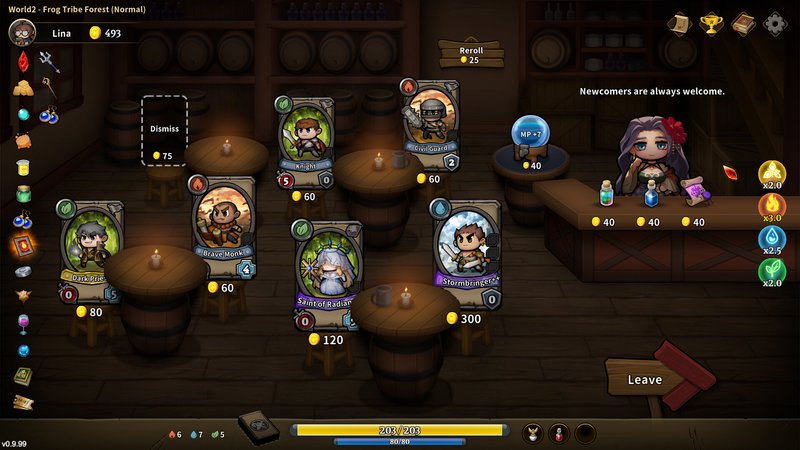
At its core, Heroes Wanted presents a color-based synergy system that attempts to differentiate itself from the now-standard paradigms established by genre luminaries. Players recruit heroes from three elemental affiliations—Fire, Water, and Earth—and arrange them into “triples” (three cards of the same element) or “straights” (one of each element) to activate powerful combinatorial effects. This central mechanic is, I must concede, conceptually sound and occasionally satisfying when executed properly.
The game’s progression follows the now utterly conventional roguelike structure: navigate a branching path map, engage in combat encounters, recruit new heroes, acquire artifacts, and ultimately challenge a series of increasingly formidable bosses. One advances through distinct “worlds,” each with its own aesthetic veneer, though the underlying gameplay loops remain largely homogeneous throughout.
Mechanical Execution: Competent, Yet Uninspired
The combat system in Heroes Wanted operates on a turn-based framework wherein players select three hero cards from their hand to form an attack formation. The positioning of these cards holds strategic significance, as certain heroes possess abilities that trigger based on their placement in this tripartite arrangement.
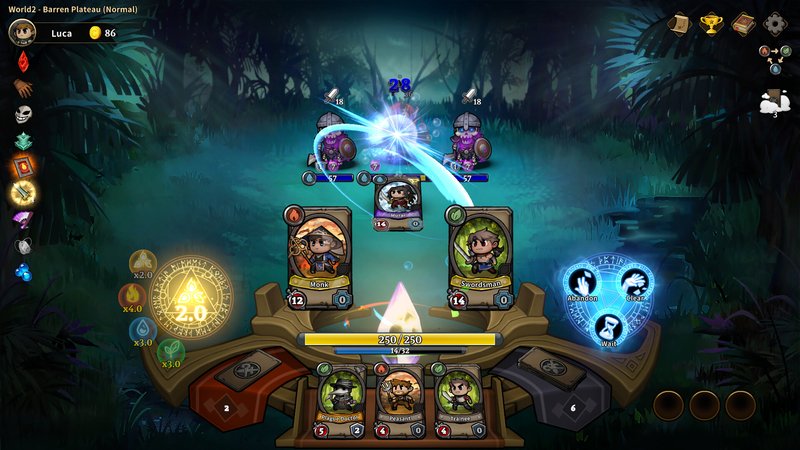
While this positional consideration introduces a modicum of tactical depth, the system ultimately lacks the sophisticated decision trees present in more intellectually stimulating titles such as Griftlands or the criminally underappreciated Gordian Quest. The elemental weakness/resistance system is implemented in a rather rudimentary fashion—enemies display their vulnerabilities prominently, and the optimal strategy typically involves simply matching your attack’s element to these weaknesses. One hardly requires a doctorate in game theory to deduce the optimal play patterns.
The deck construction aspect similarly suffers from a paucity of compelling choices. After several hours of play, I found the most efficacious strategy involved simply amassing heroes of a single elemental affinity and focusing upgrades on a small subset of cards. This approach consistently yielded superior results compared to more diversified strategies, which speaks to a fundamental imbalance in the game’s core design philosophy.
Progression and Content: Adequate, If Somewhat Pedestrian
The game boasts “hundreds of hero cards, artifacts, equipment, and consumables,” yet this numerical abundance fails to translate into meaningful strategic diversity. Many of the cards function as mere statistical variations rather than introducing novel mechanical interactions. The artifacts—ostensibly a vehicle for run-defining synergies—often provide merely incremental advantages rather than transformative effects that might substantially alter one’s tactical approach.
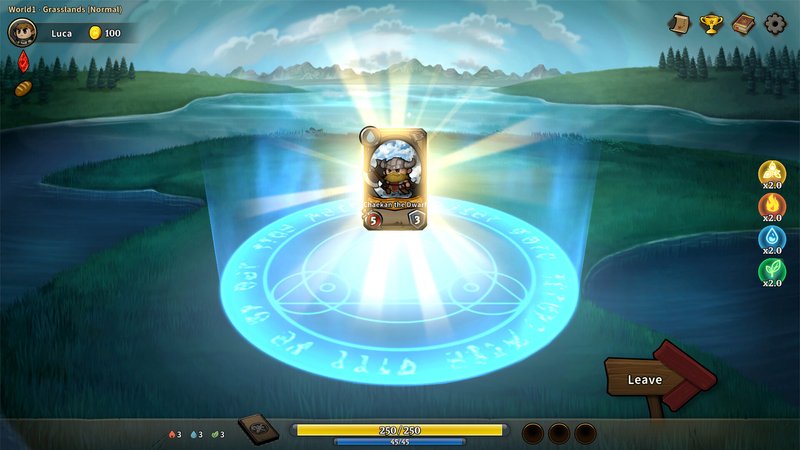
The unlock progression is particularly vexing—new content is doled out at a glacial pace, forcing players to complete multiple runs before accessing a significant portion of the game’s content. This artificial extension of the gameplay experience feels somewhat disingenuous, particularly when compared to the more elegant content distribution models employed by the genre’s more distinguished exemplars.
Aesthetic Considerations: Serviceable, Though Lacking Distinction
Visually, Heroes Wanted adopts the increasingly ubiquitous “chibi” art style, rendering its heroes as diminutive, cartoonish figures that would not look out of place in a mobile free-to-play title. While the character designs display a certain charm, they lack the distinctive visual identity that might elevate them beyond the realm of the generic.
The environments, while competently rendered, suffer from a similar absence of memorable characteristics. The various worlds—from burning villages to misty forests—are presented with adequate technical proficiency but without the artistic flourishes that might imbue them with a sense of place or atmosphere.
The audio design is similarly perfunctory—the soundtrack provides appropriate accompaniment without ever threatening to lodge itself in one’s memory, while the sound effects adequately convey the impact of attacks without demonstrating any particular creativity in their implementation.
Interface and User Experience: Functional, If Somewhat Crude
The user interface in Heroes Wanted is serviceable, presenting the requisite information in a reasonably intuitive manner. However, it lacks the refined elegance of more polished titles in the genre. Card descriptions occasionally suffer from translation issues or unclear wording, necessitating experimentation to fully comprehend certain mechanics.
The absence of a comprehensive in-game tutorial is particularly egregious, leaving players to deduce various systems through trial and error. While this approach might appeal to those who derive satisfaction from mechanical discovery, it represents a barrier to accessibility that seems unnecessary given the relatively straightforward nature of the game’s systems.
Comparative Analysis
When positioned within the broader ecosystem of contemporary deckbuilding roguelikes, Heroes Wanted occupies a distinctly middle-tier position. It lacks the innovative brilliance of Inscryption, the mechanical depth of Monster Train, or the elegant simplicity of Slay the Spire. Instead, it resides in that nebulous realm of adequate-but-unremarkable titles that might provide temporary diversion without leaving any lasting impression.
The game’s closest spiritual analog might be found in the mobile free-to-play market, where similar color-matching card systems abound. Indeed, one cannot help but wonder if Heroes Wanted might have found a more natural home on mobile platforms, where its simplified systems and accessible aesthetic would align more harmoniously with audience expectations.
Conclusion: A Modest Addition to an Oversaturated Genre
Heroes Wanted is not without merit. Its core color-matching system provides moments of satisfaction, particularly when one manages to assemble a powerful combination of heroes that synergize effectively. The progression, while slow, does offer a sense of accomplishment as new cards and artifacts are gradually unlocked.
However, these positive attributes are insufficient to elevate the game beyond the realm of the mediocre. In a genre replete with innovative and meticulously crafted experiences, Heroes Wanted fails to establish a compelling reason for its existence. It neither advances the form in any meaningful way nor executes existing paradigms with exceptional polish or creativity.
For the dedicated enthusiast of deckbuilding roguelikes who has exhausted the more distinguished offerings in the genre, Heroes Wanted might provide a few hours of mild entertainment. For others, I would suggest directing one’s attention (and financial resources) toward the numerous superior alternatives available.
The game’s asking price of $19.99 seems somewhat ambitious given its limitations, and I would counsel potential purchasers to await a substantial discount before considering acquisition.
In the final analysis, Heroes Wanted represents a competent but uninspired entry in an increasingly crowded field—neither egregiously flawed nor particularly noteworthy, destined to occupy that vast middle ground of games that are played, completed, and promptly forgotten.
Elm Whitmore, Ph.D.
Oxford University
Score
Overall Score: 5/10


Developer: Gameplete
Release Date: Jun 11, 2024
Steam Page: Heroes Wanted